

 26 October, 2026
Can Keyhole Surgery Help Knee Osteoarthritis? Understanding When Arthroscopy Works—and When It Doesn’t
“Doctor, instead of knee replacement, can you just do a small keyhole surgery and clean the knee?”
This is one of the most common questions patients with knee osteoarthritis ask.
The idea sounds very attractive.
A large surgery feels frightening. A small “keyhole” procedure sounds simpler, quicker and easier to recover from. Patients naturally wonder whether an arthroscopy can remove the damaged cartilage, clean the joint and make the knee normal again.
But there is an important point to understand:
Knee arthroscopy and knee replacement treat completely different problems.
For most people whose main problem is age-related knee osteoarthritis, routine arthroscopic “cleaning” of the knee does not reverse the arthritis or reliably provide lasting improvement.
That does not mean keyhole surgery is useless.
Arthroscopy remains an important orthopaedic procedure—but it works best when there is a specific problem inside the knee that can actually be treated through the keyhole, rather than generalized cartilage wear throughout the joint.
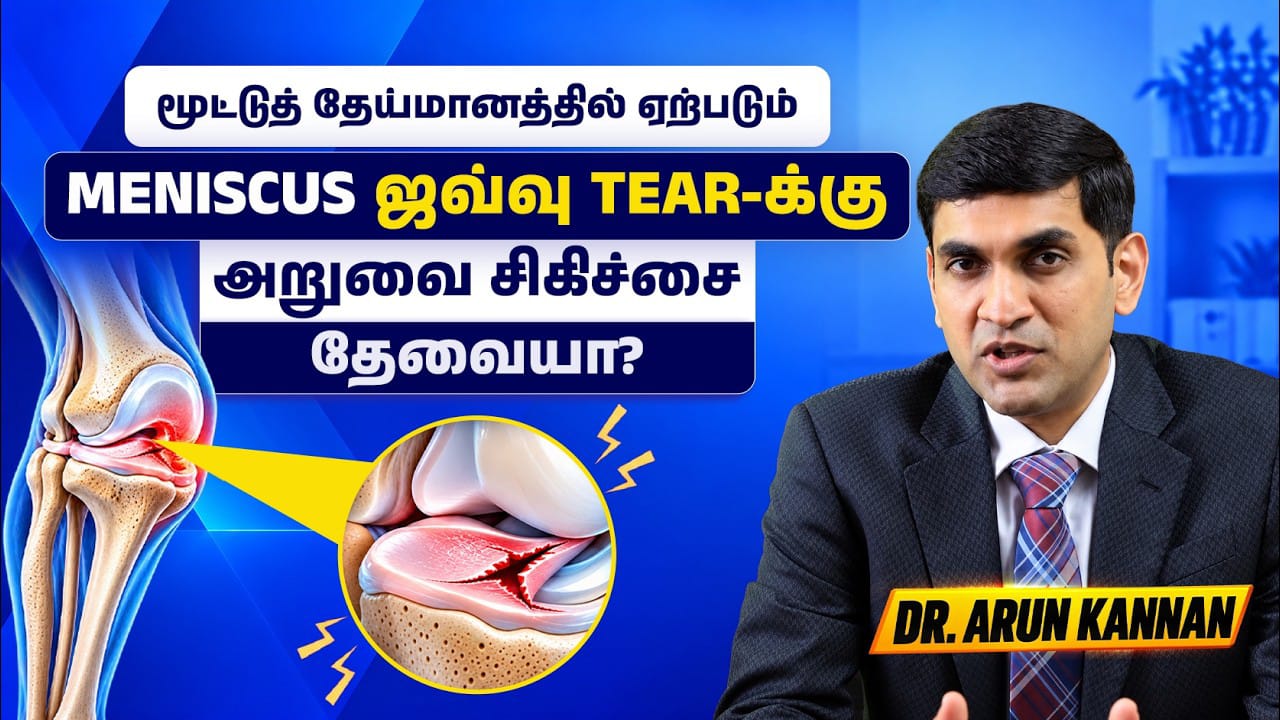
In this article, Dr. Arun Kannan, Senior Consultant Orthopaedic Surgeon at Apollo Hospitals, Chennai and Jayam Ortho Care, Kodambakkam, explains what knee arthroscopy is, why it usually does not cure osteoarthritis, when it can still be useful, and how doctors decide between physiotherapy, injections, joint-preserving procedures and knee replacement.
First, What Is Knee Osteoarthritis?
The knee is formed by the meeting of:
- Thigh bone – femur
- Shin bone – tibia
- Kneecap – patella
The ends of these bones are covered by a smooth tissue called articular cartilage.
This cartilage allows the knee to move smoothly with very little friction.
In osteoarthritis, the cartilage and other structures within the joint gradually undergo degenerative changes.
Over time, patients may develop:
- Pain
- Stiffness
- Swelling
- Reduced walking distance
- Difficulty climbing stairs
- Pain while getting up from a chair
- Difficulty squatting
- Difficulty sitting on the floor
- Grinding or cracking sensations
- Bow-leg or knock-knee deformity in advanced stages
Osteoarthritis is not simply “dirt” inside the knee that can be washed away.
It is a structural change involving the joint itself.
That difference explains why arthroscopy is not the answer for every arthritic knee.
What Is Keyhole Surgery of the Knee?
Keyhole surgery of the knee is medically called:
Knee arthroscopy
Instead of making a large incision, the surgeon makes a few very small openings around the knee.
A narrow camera called an arthroscope is inserted through one opening.
This allows the surgeon to look directly inside the joint.
Small surgical instruments can then be inserted through another opening.
Depending on the problem, the surgeon may:
- Remove a loose piece of cartilage or bone
- Treat certain meniscus tears
- Repair selected meniscal injuries
- Remove inflamed tissue
- Treat some ligament-related conditions
- Wash out an infected joint
- Examine structures inside the knee
Because the incisions are small, arthroscopy is commonly called keyhole surgery.
Why Did Arthroscopy Become So Popular for Arthritis?
Years ago, it was common to think:
“If an arthritic knee contains rough cartilage and loose debris, perhaps cleaning or washing the joint will reduce the pain.”
Surgeons sometimes performed:
- Arthroscopic lavage – washing the joint
- Debridement – trimming rough or damaged tissue
Some patients reported temporary improvement.
This created the impression that arthroscopy could be a treatment for osteoarthritis itself.
But when researchers later compared arthroscopy with good non-surgical treatment, the long-term advantage for uncomplicated osteoarthritis was not convincing.
That changed modern treatment recommendations.
Can Arthroscopy Cure Knee Osteoarthritis?
No.
Arthroscopy cannot reverse the fundamental cartilage loss of osteoarthritis.
If a patient has widespread cartilage thinning or bone-on-bone arthritis, inserting a camera into the knee and washing it does not restore the cartilage surface.
The key message is:
You can clean the joint, but you cannot clean away osteoarthritis.
Can Arthroscopy Regrow Cartilage?
No established arthroscopic procedure can reliably regrow advanced lost cartilage and return an osteoarthritic knee to normal.
Small, isolated cartilage defects in selected younger patients are a different situation and may sometimes be treated with specialised cartilage procedures.
But that should not be confused with widespread age-related knee osteoarthritis.
Then Why Do Some Patients Feel Better After Arthroscopy?
There are several possible explanations.
A patient may have had an additional problem such as:
- Loose body
- Unstable meniscus tear
- Mechanical catching
- Inflamed tissue
Treating that problem can improve symptoms.
Some patients may also feel temporarily better because:
- Swelling was reduced
- Activity changed after surgery
- Physiotherapy was started
- Pain medication was used
- They temporarily reduced high-load activities
But this does not mean the underlying osteoarthritis has disappeared.
When Is Arthroscopy Usually NOT Recommended?
If the main diagnosis is uncomplicated knee osteoarthritis with:
- Gradual pain
- Stiffness
- Pain while walking
- Pain on stairs
- General cartilage wear
routine arthroscopic washing or debridement is generally not recommended.
In this situation, the operation does not change the natural progression of osteoarthritis.
When CAN Keyhole Surgery Be Useful?
This is where the distinction becomes important.
Arthroscopy may still be appropriate when a patient has a specific mechanical or surgical problem in addition to arthritis.
1. A Truly Locked Knee
A locked knee means the joint physically cannot move normally because something is mechanically blocking it.
The patient may suddenly be unable to:
- Fully straighten the knee
- Fully bend the knee
This is different from saying:
“My knee feels stiff because it hurts.”
A true mechanical lock may be caused by:
- Displaced meniscus tear
- Loose cartilage fragment
- Loose body
In such cases, arthroscopy may be useful.
2. Loose Bodies Inside the Knee
Sometimes small pieces of:
- Cartilage
- Bone
can become loose inside the joint.
These fragments may cause:
- Catching
- Locking
- Sudden sharp pain
Removing a symptomatic loose body through arthroscopy can be reasonable.
3. Certain Meniscus Tears
The meniscus acts like a cushion inside the knee.
A traumatic meniscus tear in a younger person is very different from the degenerative meniscus changes commonly seen in an older arthritic knee.
Selected tears may require arthroscopic repair or treatment.
But:
An MRI showing a meniscus tear does not automatically mean you need arthroscopy.
Degenerative meniscal changes are extremely common as people age.
If osteoarthritis is the main cause of pain, removing part of the meniscus may not solve the underlying problem.
4. Infection Inside the Knee
A severely infected knee joint can require urgent surgical washout.
This is a completely different situation from osteoarthritis.
A patient may present with:
- Severe pain
- Hot swollen knee
- Fever
- Difficulty bearing weight
An infected joint requires urgent medical treatment.
Arthroscopy may be used to wash out the infection.
5. Selected Synovial or Inflammatory Problems
In some conditions, abnormal or inflamed tissue inside the knee may need arthroscopic treatment.
Again, these are specific indications.
They should not be confused with routine arthroscopy for osteoarthritis.
Osteoarthritis vs Meniscus Tear: Why Patients Get Confused
Imagine a 60-year-old patient with:
- Knee pain for 3 years
- Difficulty climbing stairs
- Bow-legged alignment
- Reduced joint space on X-ray
The MRI also shows a degenerative meniscus tear.
The patient may naturally think:
“The meniscus tear is causing my pain. Remove it and I will become normal.”
But in many such cases, the bigger problem is the osteoarthritis.
The meniscus change may simply be part of the degenerative process.
That is why treatment should never be based on an MRI report alone.
The MRI Must Match the Patient
Good orthopaedic decision-making involves three things:
Symptoms
Physical examination
Imaging
All three should make sense together.
An MRI abnormality that does not explain the patient’s symptoms may not require surgery.
What Are the Different Stages of Knee Osteoarthritis?
Doctors commonly describe osteoarthritis from relatively mild to advanced disease.
Early Osteoarthritis
There may be:
- Mild cartilage wear
- Early joint-space narrowing
- Small bone spurs
Symptoms may be manageable with non-surgical treatment.
Moderate Osteoarthritis
There may be:
- More significant cartilage loss
- Increased stiffness
- Reduced walking tolerance
- More frequent pain
Treatment usually remains multimodal.
Advanced Osteoarthritis
There may be:
- Severe cartilage loss
- Marked joint-space narrowing
- Bone-on-bone changes
- Deformity
- Major restriction of walking
At this stage, arthroscopy usually does not address the main structural problem.
If symptoms are severe enough, knee replacement may be more appropriate.
What Should Be Tried Before Surgery for Knee Osteoarthritis?
Many patients with mild or moderate arthritis can be treated without major surgery.
The cornerstone is usually a combination of approaches.
1. Exercise and Physiotherapy
Appropriate exercise can improve:
- Muscle strength
- Stability
- Walking ability
- Function
Important muscle groups include:
- Quadriceps
- Hamstrings
- Hip muscles
A stronger leg supports the knee more efficiently.
2. Weight Reduction
If a patient is overweight, weight reduction can make a meaningful difference.
Every step produces forces through the knee.
Excess body weight therefore increases cumulative joint loading throughout the day.
Even moderate weight reduction can improve:
- Pain
- Walking
- Overall mobility
3. Activity Modification
The aim is not to stop using the knee.
Instead, reduce activities that repeatedly overload it.
For example:
- Repeated deep squatting
- Frequent floor sitting
- Excessive stair climbing
- Repeated jumping
- High-impact running when symptomatic
can aggravate symptoms in some patients.
4. Low-Impact Exercise
Useful options may include:
- Walking at a comfortable level
- Stationary cycling
- Swimming
- Water exercise
These help patients remain active without unnecessarily loading the knee.
5. Pain Medication
Selected patients may benefit from:
- Topical treatments
- Short courses of appropriate pain-relief medication
Medication choice depends on:
- Age
- Kidney function
- Stomach problems
- Heart disease
- Other medicines
Long-term self-medication should be avoided.
6. Knee Injections
In selected patients, injections may be considered.
Options may include:
- Corticosteroid
- PRP
- Hyaluronic acid in selected circumstances
The benefits vary.
Most importantly:
No currently established injection reliably regrows severely lost cartilage or permanently cures knee osteoarthritis.
What If Non-Surgical Treatment Stops Working?
This depends on how much arthritis is present.
Some patients may be candidates for a joint-preserving procedure.
Others may benefit from:
- Partial knee replacement
- Total knee replacement
The decision depends on:
- Which part of the knee is damaged
- Severity of arthritis
- Leg alignment
- Age
- Activity level
- Symptoms
What Is High Tibial Osteotomy?
High tibial osteotomy is a joint-preserving operation used in carefully selected patients.
It may be considered when arthritis mainly affects one compartment of the knee and the leg alignment causes excessive load through that area.
Instead of replacing the joint, the surgeon changes the alignment of the bone to redistribute load.
This is generally more relevant to selected younger or active patients.
What Is Partial Knee Replacement?
If arthritis is advanced but limited mainly to one compartment of the knee, some patients may be candidates for a unicompartmental or partial knee replacement.
Only the damaged part of the knee is replaced.
Healthy portions are preserved.
However, not everyone is suitable.
When Is Total Knee Replacement Considered?
Total knee replacement may become appropriate when:
- Arthritis is advanced
- Pain is significant
- Walking is severely limited
- Everyday activities are difficult
- Sleep is affected
- Non-surgical treatment no longer provides adequate relief
The decision should not be based solely on an X-ray.
It should combine:
Severity on imaging
with
Severity of symptoms and disability.
“I Am Afraid of Knee Replacement. Can I Try Arthroscopy First?”
This is understandable.
But choosing a smaller operation does not necessarily mean choosing the correct operation.
If the knee already has advanced bone-on-bone arthritis, an arthroscopy may:
- Add another procedure
- Add recovery time
- Add cost
- Provide little meaningful benefit
- Delay definitive treatment
A procedure should be chosen because it addresses the problem—not because the incision is smaller.
Is Arthroscopy Less Risky Than Knee Replacement?
Arthroscopy is generally a smaller procedure than knee replacement.
But every surgery still carries potential risks, including:
- Infection
- Blood clot
- Bleeding
- Anaesthesia-related problems
The most important question is not simply:
“Which operation is smaller?”
It is:
“Which treatment actually matches my condition?”
Can Arthroscopy Prevent Future Knee Replacement?
For routine osteoarthritis:
No convincing evidence shows that arthroscopic washout prevents eventual knee replacement.
If the underlying cartilage degeneration continues, the arthritis can continue progressing.
Can Arthroscopy Delay Knee Replacement?
Treating a separate mechanical problem may improve symptoms in the right patient.
But arthroscopy should not be performed simply to “buy time” in an advanced arthritic knee when the main problem cannot be corrected through keyhole surgery.
What If My Knee Clicks or Makes Noise?
Clicking alone does not automatically mean arthroscopy is needed.
Many people have:
- Cracking
- Popping
- Grinding
without a surgically treatable problem.
More concerning symptoms include:
- True locking
- Repeated catching
- Sudden inability to straighten the knee
- Significant recurrent swelling
These deserve evaluation.
What If My MRI Says “Meniscus Tear”?
Do not panic.
Meniscal tears can occur because of:
Trauma
or
Age-related degeneration.
A traumatic tear causing clear mechanical symptoms may require different treatment from an incidental degenerative tear seen in an arthritic knee.
The MRI should always be interpreted together with the clinical examination.
Do I Need an MRI for Knee Osteoarthritis?
Not always.
For typical knee osteoarthritis, standing or weight-bearing X-rays may provide much of the information needed.
MRI is more useful when:
- Symptoms are unusual
- Meniscus or ligament injury is suspected
- X-rays do not explain the symptoms
- Surgery other than replacement is being considered
Can Arthroscopy Be Done With a Small Camera Only?
Arthroscopy uses a camera, but it is still an operation.
The surgeon inserts:
- Arthroscope
- Fluid
- Surgical instruments when necessary
through small incisions.
“Keyhole” should not be interpreted as “no surgery.”
How Long Is Recovery After Knee Arthroscopy?
Recovery depends on what was actually done.
Simple procedures may allow relatively rapid walking.
Repairs—particularly meniscus repairs—may require:
- Protected weight bearing
- Braces
- Longer rehabilitation
So there is no universal recovery time for “arthroscopy.”
Frequently Asked Questions About Arthroscopy and Knee Osteoarthritis
1. What is knee arthroscopy?
It is a minimally invasive operation in which a small camera and instruments are inserted into the knee through small incisions.
2. Is arthroscopy the same as knee replacement?
No.
Arthroscopy works inside the existing knee.
Knee replacement resurfaces or replaces severely damaged joint surfaces.
3. Can arthroscopy cure knee osteoarthritis?
No.
Routine arthroscopic cleaning does not reverse the underlying cartilage degeneration.
4. Can keyhole surgery regrow cartilage?
Not in widespread age-related osteoarthritis.
Selected focal cartilage injuries are a separate condition.
5. Why isn’t arthroscopic cleaning routinely recommended?
Because studies have not shown meaningful lasting benefit from lavage or debridement for uncomplicated osteoarthritis compared with appropriate non-surgical treatment.
6. Can arthroscopy remove arthritis?
No.
Arthritis involves structural changes throughout the joint.
7. When can arthroscopy help an arthritic knee?
It may help when there is another specific problem such as:
- True locking
- Symptomatic loose body
- Certain meniscus injuries
- Infection
- Selected mechanical pathology
8. What is a locked knee?
A truly locked knee physically cannot fully bend or straighten because something is mechanically obstructing movement.
9. Is stiffness the same as locking?
No.
Painful stiffness is common in arthritis.
Mechanical locking is a distinct symptom.
10. Does clicking mean I need arthroscopy?
No.
Painless clicking is common.
Persistent painful catching or locking deserves assessment.
11. My MRI shows a meniscus tear. Do I need surgery?
Not automatically.
Degenerative meniscus tears are common in people with osteoarthritis.
Treatment depends on symptoms and examination.
12. Can physiotherapy heal a meniscus tear?
It does not anatomically repair every tear, but many degenerative meniscus-related symptoms improve with rehabilitation without surgery.
13. Can I avoid knee replacement by doing arthroscopy?
Arthroscopy generally cannot replace knee replacement when advanced arthritis is causing severe disability.
14. Will arthroscopy delay my arthritis?
It does not reliably stop the natural progression of osteoarthritis.
15. Can arthroscopy make arthritis worse?
Any operation can have risks.
More importantly, unnecessary surgery may expose a patient to risk without meaningful benefit.
16. Is arthroscopy useful for Grade 2 arthritis?
If osteoarthritis itself is the only problem, routine lavage/debridement is generally not recommended.
Specific associated problems may alter the decision.
17. What about Grade 3 arthritis?
Treatment depends on symptoms and the pattern of damage.
Routine arthroscopic cleaning is still not generally the solution for osteoarthritis alone.
18. Does arthroscopy work for Grade 4 bone-on-bone arthritis?
It is very unlikely to correct the main problem.
When severe arthritis significantly affects daily life, knee replacement may be more appropriate.
19. What should I try before knee replacement?
Depending on your condition:
- Exercise
- Physiotherapy
- Weight control
- Activity modification
- Appropriate medication
- Selected injections
may be considered.
20. Is cycling good for knee osteoarthritis?
Often yes.
Stationary cycling can improve movement and muscle function with relatively low impact.
21. Should I stop walking?
Usually not.
Complete inactivity can cause muscle weakness.
Walking should be adjusted according to pain and swelling.
22. Is weight loss really important?
Yes, particularly if you are overweight.
Reducing excess weight can reduce mechanical load through the knee.
23. Can injections replace surgery?
Injections may provide temporary symptom relief.
They cannot reliably restore severely lost cartilage.
24. Is PRP better than arthroscopy?
They are completely different treatments.
Neither is a permanent cure for advanced osteoarthritis.
Treatment should match the stage and cause of symptoms.
25. When should I consider partial knee replacement?
It may be appropriate when advanced arthritis is confined to one compartment and other selection criteria are met.
26. When is total knee replacement better?
When advanced arthritis causes significant pain and disability despite appropriate non-surgical treatment.
27. Is robotic knee replacement the same as arthroscopy?
No.
Robotic assistance helps with planning and execution of knee replacement.
Arthroscopy is a keyhole procedure performed inside the existing joint.
28. Does everyone with severe arthritis need replacement immediately?
No.
The decision depends on:
- Pain
- Mobility
- Daily activities
- Imaging
- Response to treatment
29. Should surgery be decided from MRI alone?
No.
Symptoms, clinical examination and appropriate imaging must all be considered.
30. What is the most important thing to remember?
Small surgery is not automatically the right surgery.
If osteoarthritis is the main problem, the treatment should be chosen according to the stage of arthritis and how much it affects your life.
A Simple Way to Decide
Think about knee problems in three broad groups.
Mild to moderate osteoarthritis
Focus primarily on:
- Exercise
- Strengthening
- Weight management
- Activity modification
- Appropriate symptom control
Osteoarthritis plus a genuine mechanical problem
Arthroscopy may occasionally have a role after careful assessment.
Advanced osteoarthritis affecting everyday life
Discuss whether:
- Partial knee replacement
- Total knee replacement
is more appropriate.
The Most Important Question Is Not “Can Keyhole Surgery Be Done?”
Technically, arthroscopy can be performed on many knees.
But that is not the right question.
The correct question is:
“Will keyhole surgery actually treat the problem causing my pain?”
If there is a loose body or repairable mechanical problem, perhaps yes.
If there is advanced widespread cartilage loss, usually not.
Understanding that difference can save patients from undergoing an unnecessary operation.
Final Takeaway
Keyhole surgery has an important place in modern orthopaedics.
But its role must be understood correctly.
Arthroscopy is excellent for certain specific problems inside the knee.
It is not a routine cure for age-related knee osteoarthritis.
If the main problem is cartilage degeneration, simply washing or cleaning the knee will not restore the joint.
For early and moderate arthritis, treatment should concentrate on:
- Muscle strengthening
- Weight control
- Appropriate exercise
- Activity modification
- Symptom management
For selected mechanical problems, arthroscopy may be useful.
And when arthritis has become advanced enough to severely affect walking, sleep and independence, knee replacement may eventually provide a more meaningful solution.
Do not choose a procedure simply because it sounds smaller.
Choose the treatment that addresses the actual problem inside your knee.
That is how you get the best chance of meaningful pain relief and better long-term function.
Consult Dr. Arun Kannan
Dr. Arun Kannan
MS Ortho (AIIMS), FAOA (AUS), FARS (USA)
Senior Consultant Orthopaedic Surgeon
Hip & Knee Surgery, Joint Replacement and Robotic Joint Replacement
Jayam Ortho Care
4, 6th Cross Street
United India Colony
Kodambakkam
Chennai – 600024
Appointments
+91 93604 38720
044-24844718 / 24728875
Apollo Hospitals
Greams Road
Chennai, Tamil Nadu
Medical Disclaimer: This article is intended for general educational purposes only. The suitability of knee arthroscopy, injections, osteotomy, partial knee replacement or total knee replacement depends on symptoms, examination findings, imaging, age, activity level and the specific cause of knee pain. Consult a qualified orthopaedic surgeon for an individual diagnosis and treatment plan.